

Quick answer
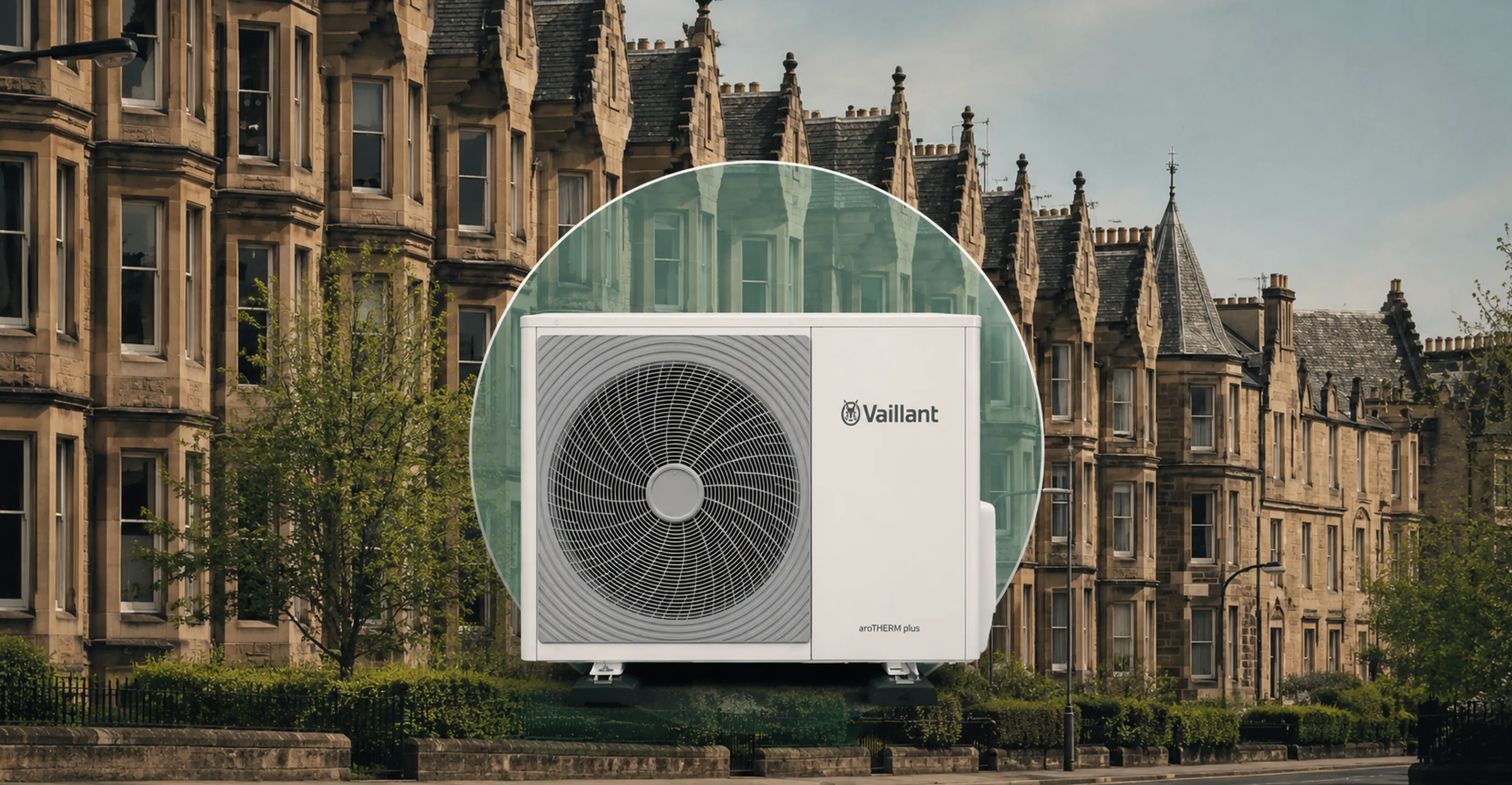
Edinburgh tenements aren't as straightforward a job
There are plenty of Edinburgh homes where looking at a heat pump is pretty straightforward.
A semi-detached house with side access, somewhere for a hot-water cylinder and an existing wet heating system is one thing.
A third-floor tenement in, for example, Morningside with a shared back green and nowhere obvious for an outdoor unit is another.
That is why we would never tell somebody their flat is suitable for a heat pump just from the postcode or a few photos.
Edinburgh has a huge number of older flats, traditional sandstone buildings, conservation areas and shared properties. The council's current Local Housing Strategy says 66% of properties in the city are flatted, so this is not some unusual edge case.
It is something that needs looked at properly.
Can a tenement flat actually run on a heat pump?
Potentially.
Old sandstone itself does not make a property unsuitable.
Heat pumps can work well in traditional buildings when the system is designed around the actual heat loss of the property.
What matters more is:
- how much heat the flat loses
- whether the radiators can deliver enough heat at lower water temperatures
- what the pipework is like
- where the outdoor unit can go
- where hot water will be stored
- whether the planning and ownership side works
A ground-floor tenement with a private rear garden and an existing radiator system may be a perfectly reasonable heat-pump candidate.
Move the same flat up three floors and make the garden shared, and the practical side gets more difficult.
That does not automatically mean no.
It just means there are more things to solve.
The outdoor unit is usually the first thing to check
Before getting too deep into heat-pump sizing, we'd want to know where the outside unit is going.
For some flats that is easy.
A private rear garden, side passage or suitable rear wall can give us a sensible location with a short pipe run.
For others there may be:
- no private outdoor space
- a shared back green
- no suitable wall
- neighbouring bedroom windows close by
- planning restrictions
- an upper-floor position that makes the pipe run awkward
This is often where tenement installations either become possible or start getting complicated.
The good news is that there is no single rule saying an Edinburgh flat cannot have an outdoor unit.
The bad news is that every building is different.
There is a strange rule in Scotland about one heat pump per building
This can catch people out.
Under the current Scottish permitted-development rules, an air source heat pump can sometimes be installed without a full planning application, provided all the conditions are met.
But Class 6H does not cover an installation that would leave more than one air source heat pump on the same building or within the curtilage of a building.
So, in a traditional Edinburgh stair with several flats, it is not simply one permitted heat pump per flat.
That sounds odd, and it is.
It is important to understand what it actually means though.
If another flat already has a heat pump, that does not automatically mean nobody else in the building can ever have one.
It means a further installation cannot rely on Class 6H. Unless another express planning permission applies, it would normally need a planning application. We have gone through how that works in Do You Need Planning Permission for a Heat Pump in Edinburgh?.
So if you are in a tenement, one of the early checks should simply be:
Is there already an air source heat pump on this building?
Planning can make some Edinburgh properties more complicated
A lot of normal domestic heat-pump installations in Scotland can qualify as permitted development.
Edinburgh is where things can get more awkward because of the amount of protected and historic housing.
Conservation areas, listed buildings and the Old and New Towns World Heritage Site can all affect what is allowed and whether a full planning application is needed.
For example, the permitted-development rules are more restrictive for a heat pump attached to a building in a conservation area.
That matters in areas such as:
- Marchmont
- Morningside
- Stockbridge
- Bruntsfield
- Newington
- parts of central Edinburgh
None of that means heat pumps are banned in those areas.
It means the siting and planning side has to be checked before anybody promises you a system. The Edinburgh planning rules for heat pumps go through the Class 6H conditions, conservation areas, listed buildings and the World Heritage Site in full.
We would rather find that problem at the start than after the design work has been done.
The wall outside your flat might not actually be yours to use
This is one of the most overlooked parts of tenement heat-pump jobs.
You own your flat.
That does not always mean you have the right to bolt equipment onto the external wall outside it.
The same goes for:
- roofs
- shared gardens
- back courts
- external walls
- other common parts of the building
Scottish tenement ownership can involve common property and shared rights, and the title deeds matter.
The default Tenement Management Scheme mainly deals with maintenance. Its majority-vote rule does not mean a majority can automatically approve new equipment fixed to a common wall, roof or garden. A heat pump may be an alteration or improvement, and consent from the co-owners of that part may be needed depending on the titles and ownership.
Do not assume that a majority is always enough. Do not assume that every owner in the stair must always agree either. If the deeds are not clear, ask the factor or a Scottish property solicitor.
Planning permission and property rights are also two different things.
The council saying a heat pump can be installed does not automatically give one flat owner the right to use a shared wall or garden.
If the proposed location involves common property, I would want that checked early.
Not after the heat pump has been ordered.
What about noise?
Heat-pump noise has to be assessed for the location. A manufacturer's headline figure does not settle it.
A unit beside a detached house with plenty of space around it is different from a tenement back court surrounded by bedroom windows.
For installations using Class 6H, the current sound calculation is MCS 020(a). It checks calculated sound at neighbouring habitable-room doors and windows; in a tenement, other flats in the same block count as neighbouring property.
That looks at more than the manufacturer's headline noise figure.
Things such as:
- distance to nearby windows
- surrounding walls
- reflections
- where the unit is positioned
can all make a difference.
This is why we do not like blanket statements such as:
"You can never put a heat pump below a bedroom window."
Sometimes the position works.
Sometimes it does not.
The calculation decides it. There is more on how noise affects the planning side in our guide to permitted development.
Will an old sandstone tenement lose too much heat?
Not necessarily.
Older buildings are often treated as if they are automatically bad heat-pump candidates, which is too simple.
Historic Environment Scotland's 2025 guide says air source heat pumps can work efficiently in traditional buildings, even where heat demand is high, when the system is designed and specified well. It does not say every old building is suitable.
The important bit is the heat-loss calculation.
A proper survey should work out how much heat each room needs on a cold winter day.
That then tells us whether:
- the heat pump is large enough
- the radiators are large enough
- any heating-system changes are needed
We would not size a system by looking at the old boiler and guessing.
That is how bad heat-pump installations happen.
Do all the radiators need changed?
Not necessarily.
Some might.
Heat pumps normally work best with lower water temperatures than a traditional boiler, so the existing radiators need checked against the heat loss of each room.
Sometimes most of them are fine.
You may find only a couple of problem rooms where the radiator is too small.
If a radiator is already big enough, there is no reason to replace it just because a heat pump is being installed.
The calculation should decide that.
Not the sales package. There is more on sizing and upgrades on our radiators page.
Hot-water storage is often the real problem in a flat
A lot of Edinburgh flats have combi boilers.
They are handy because there is no large hot-water cylinder taking up cupboard space.
A whole-home air-to-water system will usually need a suitable way to store domestic hot water.
So one of the big questions becomes:
Where does the cylinder go?
In a larger house, there may be an airing cupboard, utility room, garage or other obvious space.
In a small tenement flat, there may be nowhere sensible.
That does not always mean the heat pump is impossible. A heat battery or separate point-of-use water heaters may be options in some designs, but they are not a universal workaround. The hot-water demand, electrical supply, available space and any funding conditions still have to stack up.
But it is something that needs considered early.
If every cupboard is already being used, losing one to a cylinder is not a small detail.
Which Edinburgh tenements are easier to work with?
There is no perfect checklist, but some things generally make life easier.
A flat is more straightforward if it has:
- ground-floor or main-door access
- private outdoor space
- a sensible location for the outdoor unit
- an existing wet radiator system
- reasonable room for hot-water storage
- manageable heat loss
- clear ownership of the proposed outdoor-unit location
None of those guarantee a heat pump will be right.
They just remove some of the common obstacles.
The opposite is also true.
An upper-floor flat in a conservation area with no private outdoor space, no cylinder space and shared walls is going to need a lot more thought.
That might still be solvable.
But I would not pretend it is the same job as fitting one to a modern bungalow.
What if the flat could take a heat pump, but not yet?
Sometimes the heat pump is not the problem.
The heating system is.
You might find:
- two radiators are too small
- the controls are poor
- a section of pipework needs upgraded
- the property is losing more heat than it should
- the hot-water setup needs changed
In that situation, the answer may be to improve the property first and reassess the heat pump afterwards.
There is nothing wrong with that.
A heat pump does not become better just because it is installed this month instead of next year.
If a few sensible heating upgrades make the system work properly later, I would rather do that than force the job. We have set out what those interim upgrades usually look like in What Heating Options Are Best for Edinburgh Flats and Tenements?.
What if a heat pump genuinely is not suitable?
Then we would not fit one.
That sounds obvious, but it is worth saying.
Not every Edinburgh tenement is going to be a good candidate for an individual air source heat pump.
Planning might make the obvious location difficult.
The outdoor space may be shared.
There may already be another heat pump on the building.
There may be nowhere sensible for hot-water storage.
Or the amount of work needed to make the whole system viable may simply not make financial sense.
That is not a failed survey.
Finding that out before spending thousands of pounds is exactly what the survey is for.
And it does not mean you are out of heating options.
Depending on the property, it may make more sense to look at:
- a modern boiler
- radiator or controls upgrades
- improving the existing central-heating system
- getting the property ready for a future heat pump
- another heating system entirely
We have gone through each of those, including air-to-air heat pumps, storage heaters and communal heating for a whole stair, in What Heating Options Are Best for Edinburgh Flats and Tenements?.
The aim is not to sell a heat pump at all costs.
The aim is to work out what will heat the property properly.
Don't choose the system just because there is a grant
Home Energy Scotland funding can make a big difference to heat-pump costs.
At the time this guide was checked, eligible owner-occupiers in an existing Scottish main home could apply for up to £7,500 as a grant towards a qualifying heat pump, with a further £7,500 available as an optional interest-free loan. Funding is first come, first served, subject to the live terms and available budget. There is more detail on our heat pump grants page.
That is significant money.
It still should not be the reason you choose the system.
The property has to be suitable and the installation has to make sense. The current scheme funds air-to-water, ground-to-water and water-to-water systems that provide 100% of the home's heating and hot water. The installer and product must meet the scheme's MCS requirements.
For a clean-heat application, the live terms do not require a pre-installation EPC or energy report. A post-installation EPC and MCS certificate are needed when the funding is claimed.
Most importantly, work should not start before the homeowner has the written funding offer in place.
The funding is not retrospective.
Survey first.
Design the system.
Check the funding.
Then decide.
What would we actually look at during a tenement survey?
We aren't turning up with a heat-pump brochure and asking what colour unit you want.
We want to see the flat.
Where could the outside unit realistically go?
Who owns that area?
Is the building listed?
Is it in a conservation area?
Is there already another heat pump on the building?
Where would the pipework run?
Where would the hot-water cylinder go?
Then we get into the heating side.
Room sizes.
Heat loss.
Existing radiators.
Pipework.
Controls.
Hot-water demand.
Electrical supply.
And then there are the things that only become clear when the people living there explain how the flat actually behaves: rooms that never warm properly, rooms they rarely heat, poor hot-water performance or a cupboard that is half full of boxed-in pipework.
Those details matter.
The heating system has to work in the actual home, not just on the drawing.
Sources checked for this guide
- Scottish Government Planning Circular 1/2024 — Class 6H air source heat pumps
- MCS 020(a), Issue 1.1 — Air Source Heat Pump Sound Calculation
- mygov.scot — Tenement Management Scheme and repairs
- Scottish Government — Tenements Short Life Working Group final report
- Historic Environment Scotland — Air Source Heat Pumps in Traditional Buildings
- MCS Heat Pump Design Standard — MIS 3005-D, Issue 3.0
- Home Energy Scotland Grant and Loan — live terms and conditions
- City of Edinburgh Council — Local Housing Strategy 2025–2030
So, can you install a heat pump in an Edinburgh tenement?
Yes.
Sometimes it can be a very good option.
Ground-floor and main-door flats with somewhere sensible outside can be much easier than people expect.
Older sandstone buildings can sometimes work too.
But tenements bring extra questions around planning, shared property, outdoor-unit positioning, noise and hot-water storage.
Some flats will be straightforward.
Some will need more work.
And some simply will not be worth forcing into a heat-pump installation.
The useful answer is not:
"Do heat pumps work in tenements?"
It is:
"Does a heat pump make sense in this tenement?"
That is what the survey needs to answer.
Not sure whether your property is suitable?
If you are in Edinburgh or the Lothians and you are thinking about replacing your heating, get in touch.
We can look at the property, the existing heating system and the practical side of the job before recommending what makes sense. That is what a proper heat pump survey and installation starts with.
If a heat pump suits the property, we will tell you.
If it does not, we will tell you that too.
Book a free home survey or call us on 0131 644 0045.
Common questions
What Edinburgh flat owners ask before they spend anything on a heat pump.
Yes, potentially. Tenements are not automatically unsuitable for heat pumps. The outdoor-unit location, planning, shared property, heat loss, radiators and hot-water storage all need checked first.